
Who Gets to Answer?
Azzi Fudd's introduction to the WNBA reflects a troubling pattern in women’s sports
By Audrey Kehley
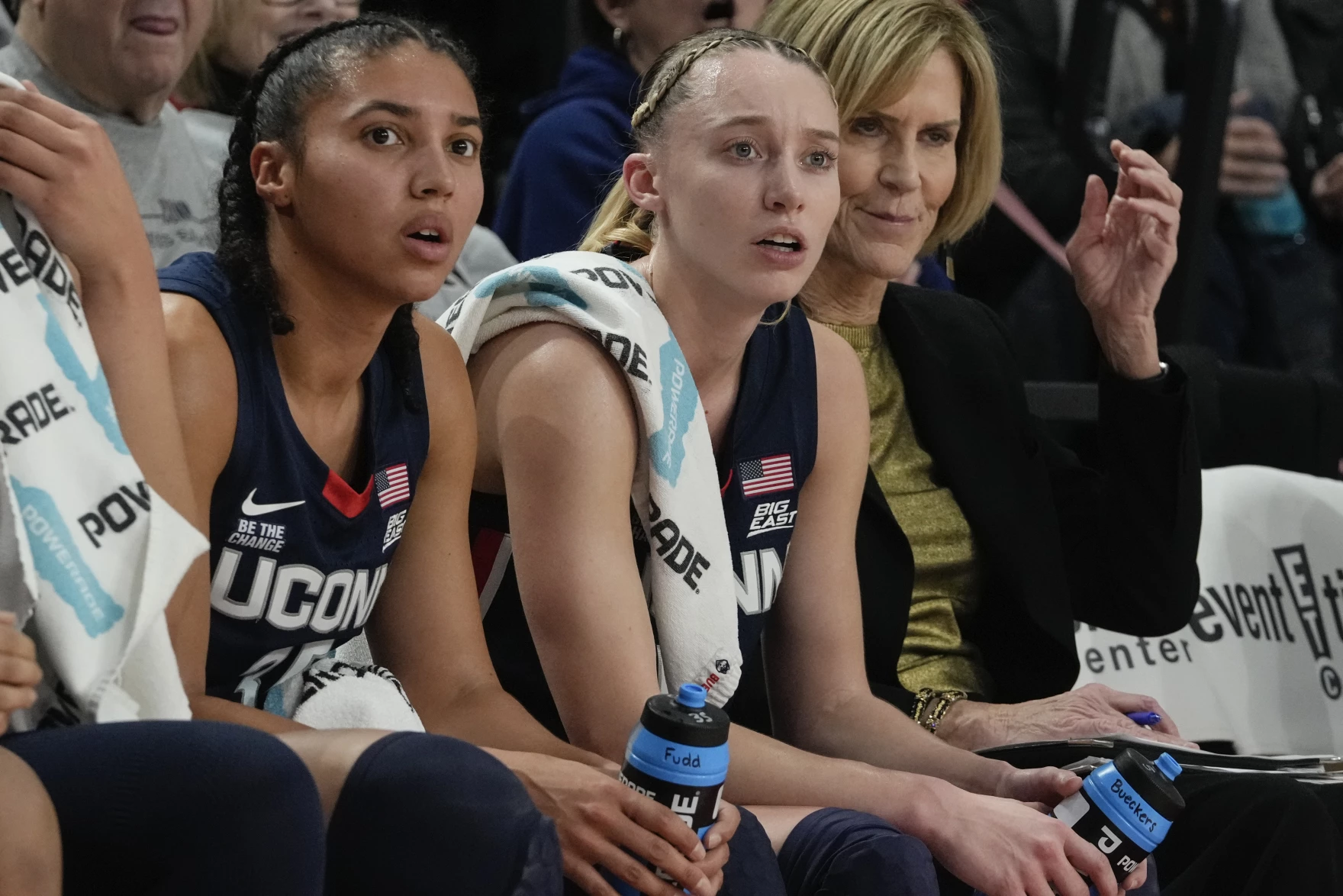
From U16 to UConn and now the Wings, Paige Bueckers and Azzi Fudd share a connection like no other in the WNBA.
A number one draft pick. A University of Connecticut star. A franchise-changing guard; titles that define both athletes.
Fudd walked across the stage on April 13, proudly holding up her No. 1 Dallas Wings jersey.
The camera pans around the room, showing her coaches, parents, and siblings, and finally gets a shot of her longtime teammate Paige Bueckers.
From a basketball perspective, it’s the most compelling storyline the league could ask for: chemistry, history, and a previous championship win under their belts.
But Fudd’s introduction to the league quickly shifted from her game to her personal life.
“Paige announced last year on TikTok that y’all were a couple, and I’m wondering if that is still the case?” Kevin Sherrington, a reporter for The Dallas Morning News, asked during Fudd’s post-draft introductory press conference.
Before Fudd could respond, a Wings PR team member shut down the question.
“I understand why you have to ask that question,” the PR team member said, “but we’re going to respectfully decline from commenting on our players’ personal lives.”
And just like that, the exchange had ended before it began.
Within moments, the clip was circulating on social media.
In a post made on Instagram by @thedailywsports, the question was called inappropriate, while also sounding the alarm on a bigger issue: how should the media handle something that has never happened before?
The comments poured in. Some called it a fair question. Others criticized it entirely.
The most common reaction: ‘You wouldn’t ask a man that.’
That reaction reflects a pattern seen too often in women’s sports: a focus on personal lives over performance and achievement.
But what made the moment stand out wasn’t the question; it was the lack of an answer.
It’s widely known that men’s and women’s sports are covered differently, not just in quantity, but also in approach.
Research supports this divide. A study by the Sport Journal shows that women’s sports often receive less coverage overall. In many cases, interviewers and commentators will frame them in a way that emphasises their appearance, emotion, or personal life over their performance. Female athletes will be diminished down to girls, while male athletes are seen as strong men.
So when Fudd was questioned about her personal relationship with Bueckers, it fit a pattern too familiar to some.
But this situation complicates that narrative.
Fudd and Bueckers have been very public about their relationship; it wasn’t new. Fans knew. Media knew. Teammates knew. Now, as professional teammates, questions about boundaries and dynamics are inevitable.
Two weeks later, on April 27, Bueckers spoke to the media herself.
“Quite frankly, I believe me and Azzi’s personal relationship is nobody’s business but our own. And what we choose to share is completely up to us,” Bueckers said.
Clear, direct, and on her own terms. Bueckers got the opportunity to set a boundary for herself; Fudd never did.
In recent years, social media has helped women’s sports grow exponentially, with coverage nearly tripling and digital platforms becoming the fastest-growing source of engagement. This has given athletes a more direct connection to fans and, in turn, boosted viewership.
Athletes can showcase their real lives, expand their fan bases, and monetize their platforms.
In that environment, reactions form instantly, often before context is understood.
When Fudd was asked about her relationship, the moment escalated when the question was shut down, leaving both the room and social media wondering why it couldn’t be addressed.
With Fudd and Bueckers, social media turned a simple question-and-answer into a referendum on how women’s sports are covered and who gets to set boundaries.
What happened on April 13 went beyond a simple exchange. It highlighted how quickly a narrative can shift in a media environment driven by intimacy.
The focus ultimately shifted away from the question itself and toward a deeper topic: who has authority to respond and on whose terms.
The WNBA has created an identity built on authenticity and player visibility. But as the league grows, it must learn how to navigate the stories that are being told, and more specifically, who gets to tell them.
Fudd and Bueckers stand at the front of that shift—the face of it.
They’re not just a story about basketball; they’re a story about changing times in media, culture, and how women’s sports will continue to adapt in 2026.
The issue isn’t that these questions exist; it’s who has the agency to answer them.
Bueckers had that opportunity; Fudd did not.
That distinction is where the true story lies.