
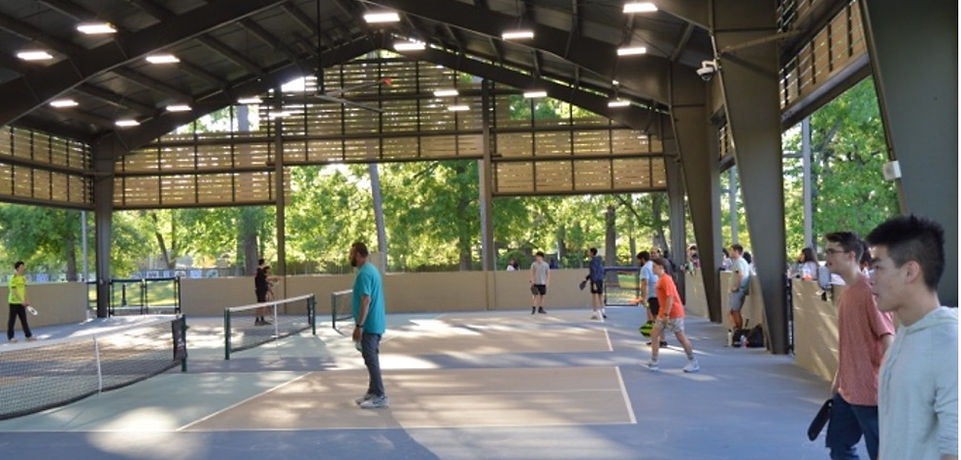
Pickleball’s rise reshapes public courts in Goose Creek
By Jordan Rawlinson
By Jordan Rawlinson
April 30, 2026
A group of preteen girls adjust their grips as coach James Martin feeds them another ball on the tennis court. Thwack.
Just a few streets down at Central Creek Park, a different sound fills the air. It’s faster, louder, sharper. Pop. Pop. Pop.
On one side, structure. On the other, rotation, laughter, and constant movement.
Two sports. One shared space. And a rapidly growing rivalry between tennis and pickleball is reshaping how public courts in South Carolina are used. Is there room for both?
“When it started happening at first, we were like ‘Oh no gracious here’s all these people who want to play a different sport,’” said United States Tennis Association of South Carolina CEO Jennifer Gregg.
As pickleball has grown, Goose Creek has grown with it.
“The old park used to have tennis courts, but we decided not to put it in because this is the growing sport right now. This is the sport that more people want,” said City of Goose Creek recreation director Rebecca Alcorn.
Central Creek Park, located in the town center, previously housed tennis courts but has since been redeveloped into eight pickleball courts. The City of Goose Creek now maintains only five public tennis courts, according to program manager Kelly Stanford, most of which are located in neighborhood and program-based spaces.
“The tennis courts in our area, nobody’s using them, so pickleball started to take over,” said pickleball player Tracy Barthold.
The energy on the pickleball court reflects that shift. Players rotate in and out of games within minutes, with little downtime and a steady stream of new faces joining in.
“It’s an addiction. Just fun, and being with friends, and movement,” Barthold said. “There’s a lot of camaraderie, and it’s brought a lot of social interaction for the community.”
Unlike tennis, where experience and instruction often shape play, pickleball offers a lower barrier of entry.
“I feel like anybody can learn and play pickleball,” said Barthold. “And anybody can get pretty good at it.”
The sport reaches across generations.
“There’s like 10-year-olds all the way up to 55 and plus that are playing,” Alcorn said.
“I’ve played elderly ladies in their upper 70s that have made me cry,” said Ed Barthold, a pickleball player in his 50s.
The sport also extends beyond traditional athletic ability.
“If you are in a wheelchair you can get into this pickleball court and you can participate and we see that,” said Alcorn.
Meanwhile, a few streets away through the winding Crowfield neighborhood, the tennis courts tell a different story.
“A lot of kids play, and their parents are now taking classes, so we have whole families out here most nights,” said Martin.
Tennis offers its own advantages, including exposure to different cultures, languages, and styles of play, according to Gregg.
“In the last few years, we have at least 100 people doing tennis in Goose Creek,” said Martin.
But growth in tennis comes with its own challenges.
“Most tennis courts are empty because it really takes a skill to play tennis, and if you don’t have instructors and locations, then you probably won’t see a lot of tennis,” said Martin.
“Not that tennis isn’t great, it’s a harder sport,” Tracy Barthold said. “But pickleball brings more people together.”
“Because it’s easy to play, you don’t really need instruction,” Martin said. “People just want to be active so pickleball is growing.”
“But tennis here is booming too,” Martin added.
As both sports continue to grow across the Lowcountry, the question is no longer which is replacing the other, but how long public spaces can support both as demand continues to rise.
With eight pickleball courts at Central Creek Park compared to five public tennis courts maintained by the city, demand for tennis facilities continues to outpace available space.
“Our problem is we’ve got too many tennis players and not enough courts,” said Gregg.
Local tennis programs and USTA South Carolina acknowledge the potential logistics issue, but they also have embraced the competition pickleball has stirred.
“Competition is a good thing. It makes you think differently. It makes you do different things. It makes you act differently,” said Gregg.